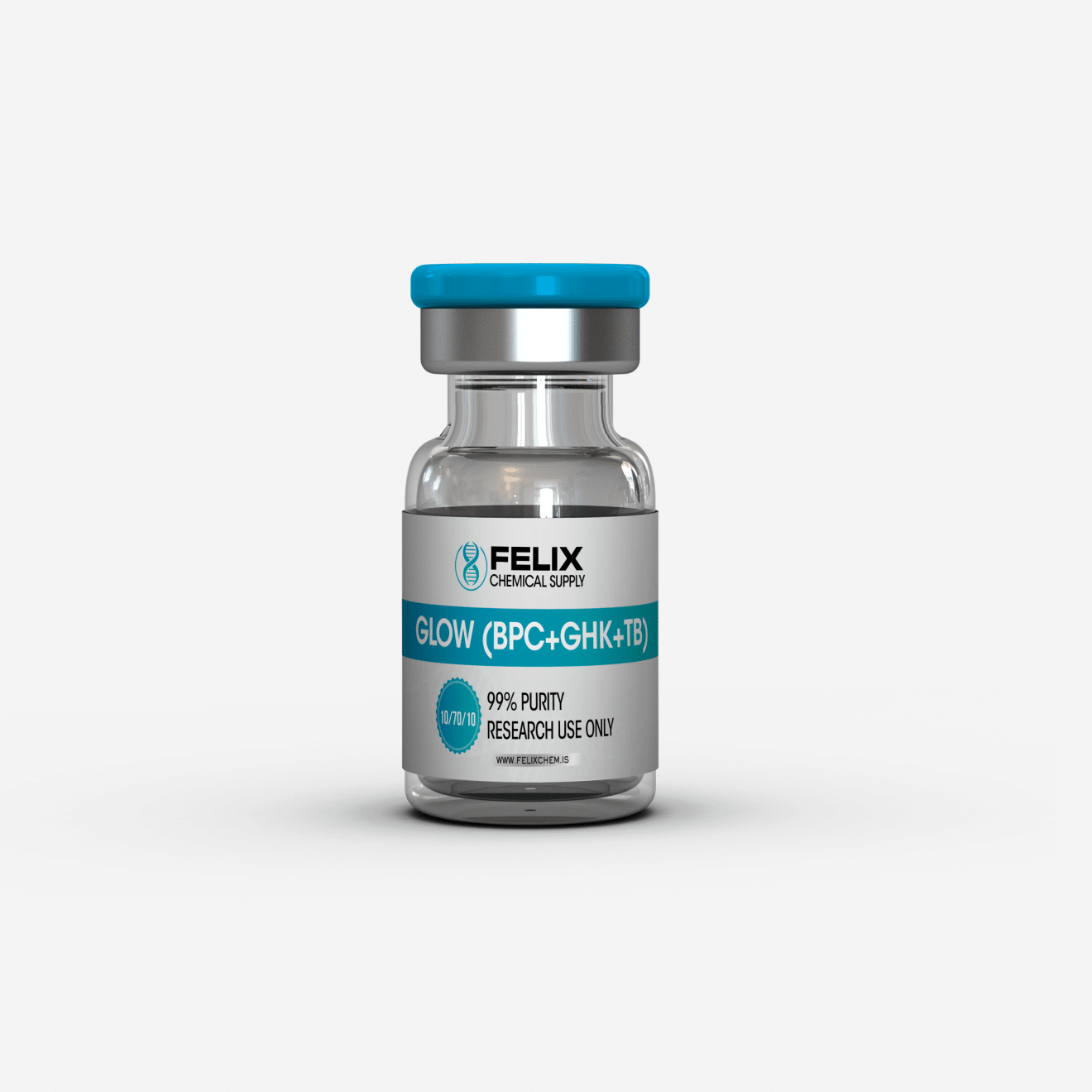
GLOW Peptide 90 mg is generally marketed as a research peptide blend rather than as a single peptide. The name “GLOW” commonly refers to a combination built around GHK-Cu, BPC-157, and TB-500, although the exact composition and quantities can vary by supplier. A 90 mg product therefore needs to be checked against the specific manufacturer’s label or Certificate of Analysis (COA) before its ingredients are assumed.
GHK-Cu (copper tripeptide-1) is a naturally occurring copper-binding peptide that has been investigated in connection with skin biology, tissue remodeling, and wound-healing processes. It is particularly associated with research into collagen and extracellular-matrix activity.
BPC-157 is a synthetic peptide that has been studied primarily in preclinical research involving tissue repair, gastrointestinal systems, and inflammatory processes. Much of the evidence comes from laboratory and animal studies, rather than well-established human clinical trials.
TB-500 is commonly described in research contexts as a synthetic peptide related to thymosin beta-4, a naturally occurring peptide involved in cellular processes such as migration and tissue remodeling. Research has examined its potential role in healing and regeneration, but evidence for therapeutic use in humans remains limited.
The 90 mg designation refers to the total amount of peptide material in the product, not necessarily 90 mg of each individual peptide. For example, if a manufacturer combines three peptides, the total 90 mg may be divided between them according to a particular formulation. The exact ratio is therefore important.
GLOW products are often promoted around concepts such as skin appearance, recovery, collagen support, and tissue repair. However, these marketing descriptions should not be interpreted as proof that the product produces those effects in humans. Research evidence for the individual peptides varies considerably, and a particular combination may not have been clinically evaluated at all.
For a research product, useful information to verify includes the exact peptide composition, amount of each ingredient, batch number, purity testing, sterility information, storage requirements, and a batch-specific COA. These details are more informative than the product name alone.



Reviews
There are no reviews yet.